
Philippines’ 2026 Minimum Wage Hike: The Philippines’ 2026 minimum wage hike has sparked heated debates across every corner of society — from labor unions and government agencies to your neighborhood sari-sari store and trending TikTok comment threads. The phrase “₱1/day increase” isn’t an official policy — it’s a public reaction to the perceived gap between minimum wage increases and the real cost of living in the country. So, is the increase actually just a peso? Is it symbolic? Or does it reflect a larger economic disconnect? This article breaks it down clearly and thoroughly — with accurate figures, historical and legal context, and practical advice for workers, employers, HR professionals, and economic observers alike.
Table of Contents
Philippines’ 2026 Minimum Wage Hike
The Philippines’ 2026 minimum wage hike is a crucial yet complex development. While regional increases have taken effect, they fall short of matching the living wage needed for millions of families. The “₱1/day” phrase is less about actual numbers and more about economic frustration. Ultimately, to create a fairer, more prosperous future, the country must balance workers’ rights with business sustainability, policy reform, and economic planning rooted in real-world conditions.
| Topic | Details |
|---|---|
| Wage System | Set regionally by the RTWPBs under DOLE. No single national wage. |
| 2026 Wage Examples | NCR: ₱695/day (non-agri), MIMAROPA: ₱455/day, Northern Mindanao: ₱485–₱500/day |
| Living Wage in NCR | ~₱1,221/day for a family of 5 (IBON Foundation) |
| Legislation In Play | House Bill 11376 proposed ₱200/day nationwide hike |
| Real Purchasing Power | Despite increases, most regions remain below living wage thresholds |
| Official Wage Info Source | National Wages and Productivity Commission: nwpc.dole.gov.ph |
What is Philippines’ 2026 Minimum Wage?
To understand the current 2026 wage situation, let’s begin with the basics. The minimum wage is the legally mandated lowest pay an employer can give a worker per day. Unlike countries like the U.S. with a federal minimum wage, the Philippines uses a regional wage system.
Under the Republic Act No. 6727, also known as the Wage Rationalization Act of 1989, the country created Regional Tripartite Wages and Productivity Boards (RTWPBs). These boards are responsible for evaluating and setting appropriate minimum wage rates for their respective regions based on:
- Local cost of living
- Inflation and economic conditions
- Industry productivity
- Unemployment rates
This system allows flexibility and fairness on paper, but in practice, it has led to major regional disparities in income.
What Happened in 2026?
Metro Manila (NCR)
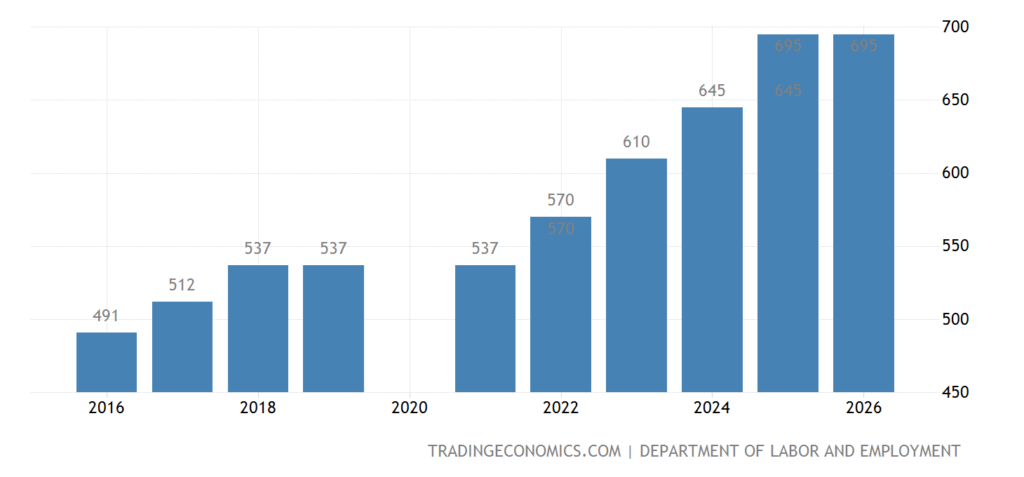
In 2025, the RTWPB-NCR approved Wage Order No. NCR-26, raising the daily minimum wage to ₱695/day for non-agricultural workers and ₱658/day for agricultural and retail workers.
This is the highest minimum wage in the country and affects over 1.1 million workers directly — and millions more indirectly.
MIMAROPA and Other Regions
As of January 2026:
- MIMAROPA’s daily minimum wage is now ₱455, up from ₱430 and ₱404 depending on establishment size.
- Domestic workers in MIMAROPA and several regions must now receive at least ₱7,000/month.
Northern Mindanao
Northern Mindanao rolled out a ₱39 increase in two tranches, raising the minimum to ₱485–₱500/day by May 2026.
Despite these increases, many labor groups argue they fall short of bridging the gap between income and living costs, especially with food inflation and rising utility bills.
Why People Say “₱1 a Day”?
The term “₱1/day increase” gained traction online not as an official figure, but as a symbol of public frustration. It sarcastically highlights the slow pace and perceived inadequacy of wage hikes in the face of soaring inflation and stagnating purchasing power.
In reality, most regional wage boards approved increases ranging from ₱30 to ₱50/day, but when compared to the cost of living, those hikes feel symbolic rather than transformative.
The Real Gap: Minimum Wage vs. Living Wage
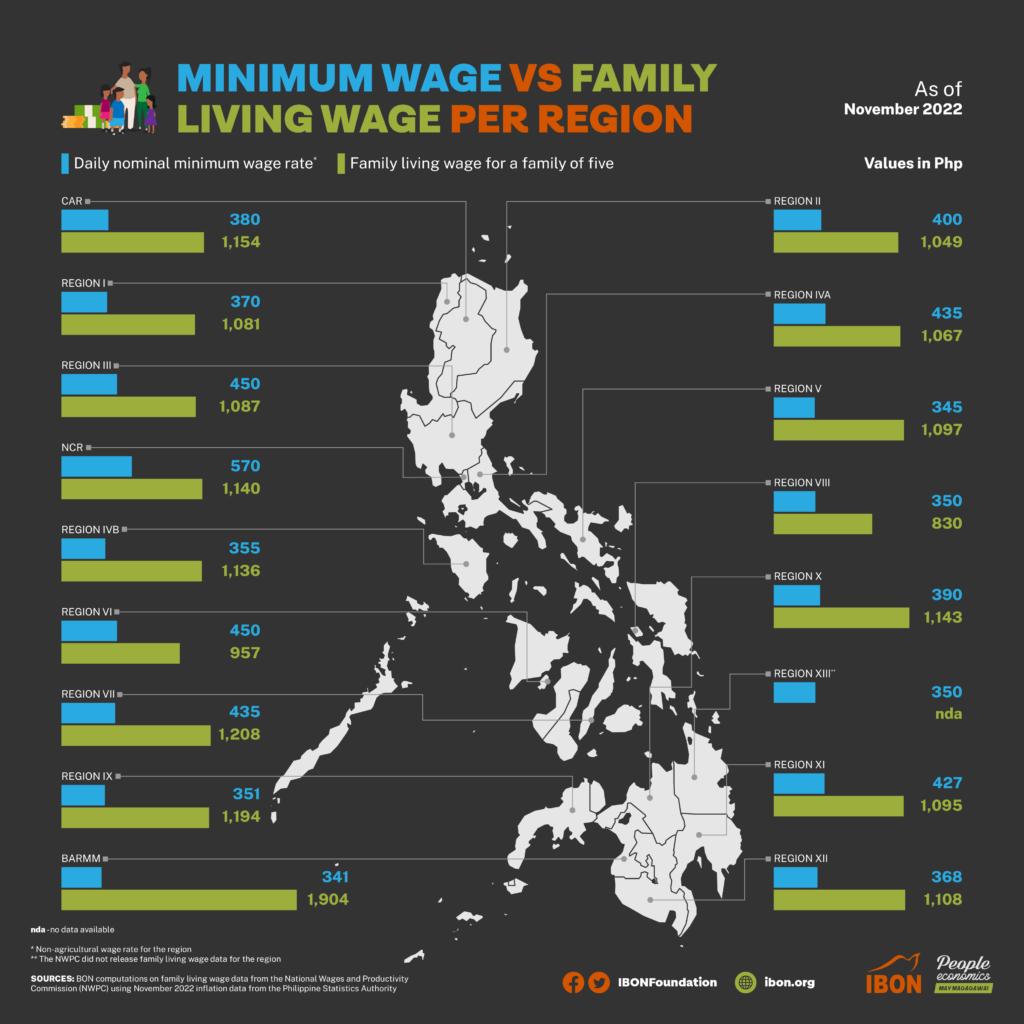
A living wage is the amount a worker needs to sustain a basic but decent standard of living for themselves and their family. It includes food, housing, utilities, education, healthcare, and some savings.
According to the IBON Foundation, as of 2025:
- A family living wage in NCR for a family of five is ₱1,221/day
- The current minimum wage of ₱695/day covers only about 56% of that need
That shortfall translates to economic strain, more debt, and deeper poverty cycles for millions of wage earners.
What the Government Says About Philippines’ 2026 Minimum Wage Hike?
The Department of Labor and Employment (DOLE) defends the regional wage system as a balanced mechanism. Officials argue that:
- Sudden, drastic nationwide hikes could result in mass layoffs, particularly among small businesses
- Regional wage boards are best suited to assess local conditions
They also emphasize the importance of productivity-based pay and non-wage benefits like tax breaks, bonuses, and employee skills training.
However, critics claim this stance underestimates the urgency of inflationary pressures on the poorest Filipinos.
Legislative Angle: House Bill 11376
In response to these issues, lawmakers in the House of Representatives passed House Bill No. 11376, which proposes a ₱200/day nationwide increase across all private-sector workers, regardless of region.
The bill argues that:
- Regional wages have failed to protect workers
- Inflation has outpaced wage growth
- A national baseline is needed for equity and economic dignity
As of 2026, the bill is still under deliberation in the Senate.
Global Comparisons
To put things into perspective:
- Indonesia’s 2026 average minimum wage is about IDR 2,200,000/month (~₱8,400), but with significantly lower living costs
- Vietnam’s minimum wage ranges from ₱7,000 to ₱11,000/month, depending on region
- In contrast, the Philippine monthly minimum wage for many regions barely crosses ₱10,000–₱14,000
Yet the Philippines has higher food, fuel, and education costs than many Southeast Asian peers, increasing the strain on Filipino families.
Economic Impact on Businesses
From the employers’ side, wage hikes come with added costs that could:
- Squeeze small and medium enterprises (SMEs)
- Lead to hiring freezes or layoffs
- Force price increases for products and services
However, many economists argue that higher wages improve worker productivity and loyalty, leading to better business performance in the long term.
Balancing wage increases with fiscal sustainability is crucial — and something the regional system struggles to do effectively.
Practical Advice for Workers
- Check Your Regional Wage Order
Visit nwpc.dole.gov.ph and confirm your region’s current minimum wage. - Audit Your Payslip
Ensure your employer is complying with updated wage rates. Keep records for future reference. - Improve Your Skillset
Upskilling through TESDA, online courses, or trade apprenticeships can increase your value and bargaining power. - Join a Union or Workers’ Group
If possible, collective action helps push for fairer wages and benefits.
Practical Advice for Employers and HR Professionals
- Stay Compliant
Non-compliance with wage orders can lead to fines, back-pay penalties, and reputational damage. - Use a Payroll System
Automate wage updates by integrating payroll with local wage board data. - Communicate Transparently
Talk to your staff about how wage increases impact company finances and future planning. - Explore Benefits Beyond Cash
Health insurance, flexible work, or transportation allowances can help improve employee retention.