
5 Ultra-Rare Coins Worth Millions: If you’ve ever rummaged through your pocket change or peeked into Grandpa’s coin collection, you might’ve held onto a coin wondering, “Is this worth something?” It’s a common thought — and sometimes, it’s absolutely true. Some coins hiding in old drawers or coin jars are worth thousands or even millions of dollars today. From gold doubloons to error dimes, the world of rare coins is packed with surprises. This guide will walk you through the five ultra-rare U.S. coins worth millions, show you why they’re valuable, and teach you what to look for before you give away that Roosevelt dime.
Table of Contents
5 Ultra-Rare Coins Worth Millions
Ultra-rare coins like the 1933 Double Eagle, 1794 Silver Dollar, and 1894-S Barber Dime have become legends — not just because they’re worth millions, but because they carry stories of history, scarcity, and wonder. Even ordinary coins like Roosevelt dimes can hold value if they feature rare minting errors or missing marks. Before you toss that old dime into a vending machine or roll up coins for the bank, take a second look. With a little knowledge and a careful eye, you just might discover a piece of American history — and a fortune.
| Coin Name | Year | Approx. Auction Value | Rarity Reason |
|---|---|---|---|
| 1933 Saint-Gaudens Double Eagle | 1933 | ~$18.9 million | Gold recall; not released into circulation |
| 1794 Flowing Hair Silver Dollar | 1794 | ~$10 million+ | First U.S. silver dollar |
| 1787 Brasher Doubloon | 1787 | ~$9.3 million | Pre-U.S. Mint handmade gold coin |
| 1913 Liberty Head Nickel | 1913 | ~$3–5 million | Unauthorized minting; only 5 exist |
| 1894-S Barber Dime | 1894 | ~$1.4–1.9 million | Only ~9 surviving specimens out of 24 made |
1933 Saint-Gaudens Double Eagle — The Most Valuable U.S. Coin
The 1933 Saint-Gaudens Double Eagle is often called the “King of American Coins.” Designed by famed sculptor Augustus Saint-Gaudens, this $20 gold coin is stunning in design and unmatched in mystery.
Why it’s rare: Although over 445,000 of these coins were minted, they were never officially released into circulation. Due to the Gold Reserve Act during the Great Depression, the government ordered all gold coins melted down — and nearly all of them were. But a handful escaped.
In 2002, a single legal specimen sold for $7.6 million. In 2021, it sold again for $18.9 million at a Sotheby’s auction, making it the most expensive U.S. coin ever sold.
Legal warning: Many 1933 Double Eagles floating in private hands are technically illegal to own unless cleared by the U.S. Treasury. If you think you’ve found one, get legal advice and professional authentication.
1794 Flowing Hair Silver Dollar — First of Its Kind
Believed to be the first silver dollar ever struck by the U.S. Mint, the 1794 Flowing Hair Silver Dollar is a cornerstone of American numismatic history.
Why it’s valuable: It represents the dawn of American currency. These coins were produced in very limited quantities and with rudimentary minting equipment, making high-quality specimens almost nonexistent.
In 2013, a nearly perfect example sold for over $10 million.
What to look for: The obverse features a bust of Liberty with flowing hair, and the reverse shows a small eagle perched on a rock. If you’re holding something even close to this, get it authenticated — even worn examples are valuable.
Fun fact: Many numismatists believe this coin was struck with extra care to impress foreign dignitaries, highlighting the United States’ new independence.
1787 Brasher Doubloon — The Gold Coin Before the Mint
The Brasher Doubloon was created by goldsmith Ephraim Brasher in 1787 — before the U.S. Mint existed. These handcrafted coins are among the rarest and most significant pieces of American history.
Only a few known examples exist, and each has unique characteristics. Some have Brasher’s “EB” hallmark on the eagle’s wing, while others bear it on the breast.
In 2021, a Brasher Doubloon sold for $9.36 million, proving that pre-federal American coinage is just as treasured — if not more — than federally minted coins.
Tip: If you’re handed an old gold coin that doesn’t quite look like a modern piece, and it bears a strange “EB” punch, don’t clean it or try to sell it online. Call a coin expert or auction house immediately.
1913 Liberty Head Nickel — The Coin That Wasn’t Supposed to Exist
This nickel’s origin is steeped in secrecy and scandal. The 1913 Liberty Head Nickel wasn’t listed in official U.S. Mint records, yet five of them were mysteriously struck — most likely by a mint employee.
These coins are legends in the collecting community. They’ve been featured on TV shows, displayed in museums, and sold at elite auctions.
One of these nickels sold for $4.56 million in 2018. That’s not bad for five cents.
What makes it special:
- Liberty Head design was phased out in 1912
- Only five 1913 nickels exist
- Each has a well-documented ownership history, adding to their mystique
Realistically, you won’t find one in your change, but you’ll often hear stories of collectors discovering “old nickels” in estate sales. Always research before selling — sometimes, things aren’t what they seem.
1894-S Barber Dime — The Million-Dollar Dime
You read that right — a dime worth over a million dollars.
Only 24 Barber dimes were minted at the San Francisco Mint in 1894, and fewer than 10 have survived. The reason for the limited mintage remains unclear, but it’s believed the coins were produced for special purposes — possibly for VIPs or internal use.
A well-preserved example of this tiny coin sold for $1.9 million in 2016.
Identifying it:
- Date: 1894
- Mint mark: Look for an “S” below the wreath on the reverse
- Liberty head on the front, typical of Barber coins from 1892–1916
And yes, it’s called a “Barber dime” because it was designed by Charles E. Barber, the Chief Engraver of the U.S. Mint.
So… Are There Roosevelt Dimes Worth Big Money?
Roosevelt dimes were introduced in 1946 to honor President Franklin D. Roosevelt. Most are common, even the earlier silver ones from 1946 to 1964, which are worth around $1–$3 in silver content.
But a few rare variations and errors can command huge premiums:
1. 1975 “No S” Proof Dime
- Missing mint mark
- Only a couple known
- Value: Over $400,000
2. 1968 “No S” Proof Dime
- Also extremely rare
- Auction value: Over $30,000
3. Major die errors
- Off-center strikes, double dies, and wrong planchets can all raise value significantly
What you can do: If you’ve got a proof coin (very shiny, mirror-like) from the late ’60s or ’70s, check for the mint mark. If it’s missing, that’s worth checking out.
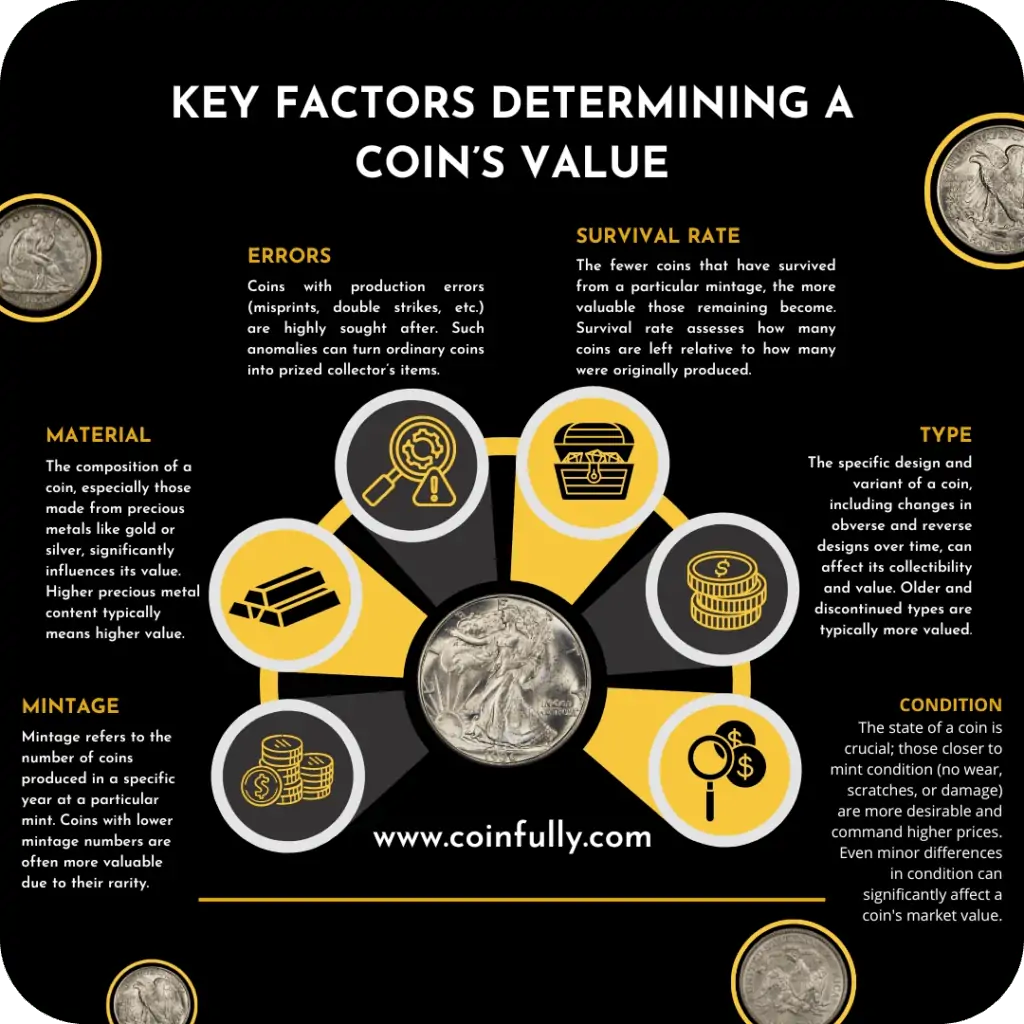
How to Tell If You have Ultra-Rare Coins Worth Millions?
If you think you’ve found something valuable, follow these steps:
1. Inspect the date and mint mark.
Mint marks like “D” (Denver), “S” (San Francisco), or “P” (Philadelphia) are small letters found on most U.S. coins. Their presence or absence can make a big difference.
2. Check the condition.
Coins are graded from 1 (poor) to 70 (perfect). Even rare coins in bad shape might fetch less than perfect examples. Grading helps determine worth and authenticity.
3. Look for errors.
Die cracks, doubling, off-center strikes, and missing elements (like mint marks) can create huge value spikes. Always inspect both sides under magnification.
4. Use trusted resources.
Websites like PCGS, NGC, and USA Coin Book offer free lookup tools and price guides.
5. Don’t clean the coin.
Seriously, don’t. Cleaning coins can scratch them and destroy their value. Always keep them as-is.
6. Get it professionally graded.
If you think your coin is rare, submit it to PCGS or NGC. Certified coins sell for more and are easier to insure and trade.
11-Year Rise of Rare Wheat Pennies: Which Coins Became Goldmines for Collectors?
These 10 Coins Could Be Worth Much More by 2050 – Valuable Pennies to Keep!
U.S. Coin Values in 2025: Hidden Treasure in Your Pocket With These 3 Rare Finds